

How chocolate is made?
Cocoa beans go a long way before they can be made into chocolate. Freshly gathered beans have an intensive, sour-and-bitter taste, which is nothing like the chocolate sweetness we know. That is why, until the 18th century some South American tribes gathered cacao fruits not because of their precious seeds, but for the sweetish pulp which surrounds them. During the hundreds of years of bringing cacao beans processing to perfection, a multistage process was developed, thanks to which in chocolate there is no trace of the tart taste characteristic of the beans.
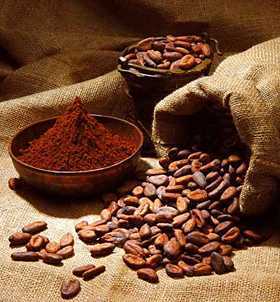
Cocoa beans
Cocoa beans undergo initial processing before they leave the plantation. The beans are taken out of their pods and subjected to a fermentation process in special containers. Within 3-6 days, saccharides from the pulp surrounding the beans decompose into alcohol and then into acetic acid. After the fermentation beans may contain up to 60 per cent of water, and so they must be dried. The simplest way is to spread them on mats or sun-heated ground.
Roasting cocoa beans
This is a very important stage, during which any excessive amount of water is evaporated from the beans. At this stage a large part of sour substances evaporates as well, which improves the flavour of the beans. Before roasting, the beans must be carefully sorted. Any crumbled beans are separated from whole beans which are segregated according to size and roasted separately. This process prevents non-uniform heating of the beans, because over-roasted beans lose part of their taste qualities and become more bitter.
Preparation of cocoa nibs
Special machines are used in this process in order to separate shells and germs from the kernels. The resulting product, called cocoa nibs, undergoes separation from the shells at the subsequent stage where a system of sieves with different hole sizes is used.
Preparation of cocoa liquor
Cocoa nibs are thoroughly ground in special mills, where cells are cracked open to free the fat. This butter gives the obtained mass a half-liquid consistency (paste).
What is cocoa liquor?
Cocoa pulp is a key intermediate in the chocolate production process. The high content of cocoa liquor and cocoa butter is one of the hallmarks of high-quality chocolate. In product packaging, the proportion of cocoa liquor and fat by weight is referred to as “cocoa content”.
Liquefying
Cocoa mass is the basic half-product for chocolate production. The second indispensable ingredient is the cocoa fat pressed from the mass. Before actual pressing the cocoa mass is left to ripen, by heating and stirring it in special containers. The liquefying process itself takes place in hydraulic presses. After the fat is separated from the mass in the press the so-called cocoa press cake is obtained, used i.a. for the production of cocoa powder.
Cocoa cook
This is a residue from the cocoa butter (fat) separation process. The cook is ground and sieved, resulting from the division of the finely ground cocoa mass. The result is cocoa powder, which is used, among others, in the production of cocoa beverages.
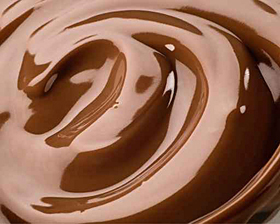
Mixing cocoa mass with butter
Cocoa mass is mixed with cocoa butter in such proportions as to achieve a product with about 30 per cent of fat. Sugar is also added at this stage.
Conching chocolate
This is a very important stage in chocolate production. It consists in intensive and long-lasting mixing of the liquid mass (liquor) in heated conches. After the conching process chocolate becomes milder to taste, losing much of the bitterness and gaining a smoother texture. This occurs due to the reduction of water in mass, reduction of the amount of volatile acids and tannins. The process of conching chocolate takes 72 hours on average, up to a week. Depending on what the final product is to be, in the last stage of conching, other ingredients enriching the taste, e.g. vanilla, may be added.
Tempering and melting chocolate – methods and temperatures
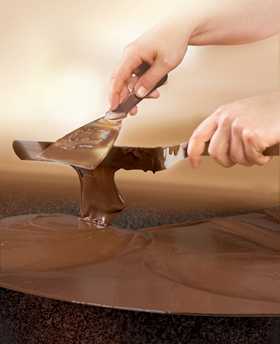
Chocolate tempering is the controlled pre-crystallisation of the cocoa butter contained in chocolate. It gives the finished product a clean snap and gloss after cooling. During tempering, the liquid chocolate mass is cooled. This is a complex process because chocolate contains several crystal forms of cocoa butter, each with a different setting temperature. If cooling is carried out incorrectly, some fats will not set and may appear as bloom on the surface of the chocolate.
Correct tempering also allows finished pieces to be released easily from their moulds after cooling.
Different crystal types:
- unstable crystals: alpha, beta-prime
- the more stable beta crystal
3 key parameters:
- time – an essential parameter for tempering chocolate correctly. Too short a tempering time will not be sufficient to temper the chocolate adequately.
- agitation – affects the speed of the reactions taking place. If the chocolate is not stirred during tempering, the temperature may not be distributed evenly, increasing the risk of scorching.
- temperature – the temperature range below should be used according to the type of chocolate. Tempering temperatures vary because each type contains a different amount of cocoa butter. The high sugar content of white chocolate makes it more difficult to melt without scorching; therefore, it should be melted at a lower temperature than dark or milk chocolate.
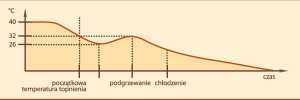
Tempering curve
- Dark chocolate – cool to 28°C, then reheat to 32°C
- Milk chocolate – cool to 27°C, then reheat to 31°C
- White chocolate – cool to 26°C, then reheat to 30°C
Cocoa butter differs from other fats in many respects, above all in its consistency. At 20°C it is hard, brittle and has a conchoidal fracture. Cocoa butter retains its firm consistency even close to its melting point.
Cocoa butter changes state at the following temperatures:
- initial melting point – 31–34°C,
- final melting point – 33–36°C,
- setting point – 23–28°C.
Tempering methods:
Tempering with callets
- melt the chocolate at 40–45°C,
- add 1/5 of the callets and stir,
- cool to 31–32°C.
Tempering on a cool marble slab
- melt the chocolate at 40–45°C,
- pour 60% of the chocolate onto the slab,
- work it until the chocolate thickens,
- mix it with the remaining melted chocolate.
Tempering in a wheel tempering machine
- melt the chocolate at 40–45°C,
- set the thermostat to 32°C for dark chocolate and 30°C for milk or white chocolate,
- add approximately one fifth of the callets to the melted chocolate,
- stir.
Tempering in a microwave
- place the callets in a bowl,
- melt the chocolate at a maximum power of 800 W,
- stir the callets every few seconds,
- continue stirring until only small pieces of chocolate remain visible,
- remove from the microwave and stir until the chocolate has melted completely.
Melting chocolate
Methods for melting chocolate
Melting chocolate in a bain-marie
Finely chop the chocolate, then place it in a bowl. Set the bowl over a larger pan of simmering water. The water level should reach three quarters of the height of the bowl. Stir the melting chocolate continuously.
Melting chocolate in a saucepan
Break the chocolate into smaller pieces and place it in a saucepan. Heat gently, stirring continuously.
Melting chocolate in a microwave
Break the chocolate into small pieces and place them in a glass bowl. Set the microwave to maximum power for 10 seconds. Stir the chocolate, then return it to the microwave for a further 10 seconds. Repeat until the chocolate is completely melted.
Melting curve
Chocolate melting temperatures
- Dark chocolate:
- 30–32°C – begins to soften
- 33–35°C – most cocoa butter crystals melt; the chocolate becomes soft and melts in the mouth
- 38–42°C – thickly fluid, though small unmelted crystals may remain
- 45–50°C – completely fluid and homogeneous
Do not exceed 50°C, as excessive heat can impair the flavour, aroma and cocoa butter crystallisation properties.
- Milk chocolate:
- 28–30°C – begins to soften
- 32–35°C – most cocoa butter crystals melt; the chocolate becomes soft
- 36–39°C – thickly fluid, though small unmelted crystals may remain
- 40–45°C – completely fluid and homogeneous
Do not exceed 45°C to avoid scorching the milk solids and compromising quality, as above.
- White chocolate:
- 28–30°C – begins to soften
- 32–35°C – most cocoa butter crystals melt; the chocolate becomes soft
- 36–38°C – thickly fluid, though small unmelted crystals may remain
- 38–43°C – completely fluid and homogeneous
Do not exceed 45°C to avoid scorching the milk solids and compromising quality, as above.
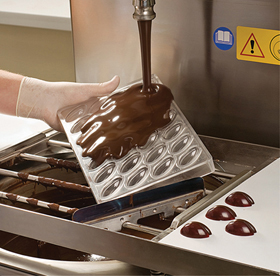
Moulding chocolate and types of chocolate products
After tempering, the chocolate mass becomes fluid and can be poured easily into moulds. The depositing temperature is approximately 28°C, while the moulds are around 2°C cooler, allowing the chocolate to release cleanly from the mould walls. Once the chocolate has set, the moulds are simply inverted and the bars are sent to packing. Appropriate packaging enables the chocolate’s flavour and aroma to be enjoyed for a long time.
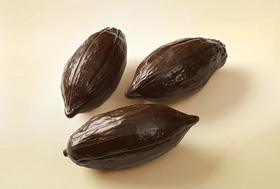
Cocoa powder
Cocoa powder is a product obtained by pulverising cleaned, defatted and roasted cocoa beans, containing:
1) not less than 20% cocoa butter, calculated on a dry-matter basis;
2) not more than 9% water.
Chocolate
Chocolate is a product obtained from cocoa products and sugars, containing not less than 35% total dry cocoa solids, including:
1) not less than 18% cocoa butter;
2) not less than 14% fat-free dry cocoa solids.
Explore dark chocolates in the Barima Artisanal catalogue
“Couverture” chocolate
Couverture chocolate is a product obtained from cocoa products and sugars, containing not less than 35% total dry cocoa solids, including:
1) not less than 31% cocoa butter;
2) not less than 2.5% fat-free dry cocoa solids.
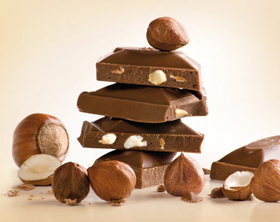
Nut Chocolate “Gianduja”
Gianduja chocolate is a product containing:
1) chocolate with not less than 32% total dry cocoa solids, including not less than 8% fat-free dry cocoa solids;
2) 20–40 grams of finely ground hazelnuts per 100 grams of product;
3) optional additions:
a) dry milk solids obtained by evaporation from milk or milk products in powder form, not exceeding 5% of the product;
b) almonds, hazelnuts or other nuts, whole or in pieces, in an amount not exceeding 60% of the total weight of the product.
Explore nut products in the Barima Artisanal offer
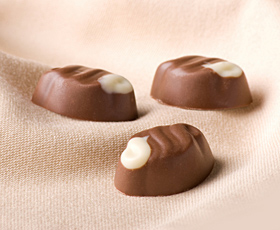
Milk chocolate
Milk chocolate contains:
1) 25% total dry cocoa solids;
2) 14% dry milk solids obtained from:
a) partially or wholly dehydrated whole milk; or
b) partially or wholly skimmed milk; or
c) cream; or
d) partially or wholly dehydrated cream; or
e) butter; or
f) milk fat;
3) 2.5% fat-free dry cocoa solids;
4) 3.5% milk fat;
5) 25% total cocoa butter and milk fat.
Explore milk chocolates in the Barima Artisanal catalogue
Milk couverture chocolate
Milk couverture chocolate is a product obtained from cocoa products, sugars and milk or milk products, containing not less than 31% total cocoa butter and milk fat.
Milk gianduja chocolate
Milk gianduja chocolate is a product obtained from cocoa products, sugars and milk or milk products, containing:
1) milk chocolate with not less than 10% dry milk solids obtained from:
a) partially or wholly dehydrated whole milk; or
b) partially or wholly skimmed milk; or
c) cream; or
d) partially or wholly dehydrated cream; or
e) butter; or
f) milk fat;
2) not less than 15 and not more than 40 grams of finely ground hazelnuts per 100 grams of finished product;
3) optional additions of almonds or nuts, whole or in pieces, in an amount not exceeding 60% of the total weight of the product.
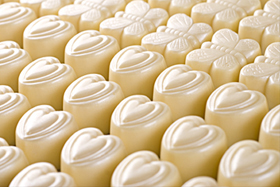
White chocolate
White chocolate is a product obtained from cocoa butter, sugars and milk or milk products, containing not less than:
1) 20% cocoa butter;
2) 14% dry milk solids obtained from:
a) partially or wholly dehydrated whole milk; or
b) partially or wholly skimmed milk; or
c) cream; or
d) partially or wholly dehydrated cream; or
e) butter; or
f) milk fat;
3) 3.5% milk fat.
Explore white chocolates in the Barima Artisanal offer
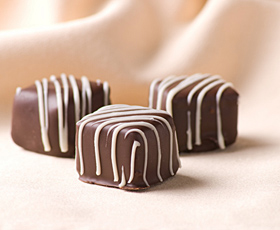
Chocolate confection (praline)
A chocolate confection, or praline, is a small, bite-sized product consisting of:
1) filled chocolate; or
2) a single type of chocolate; or
3) a mixture of chocolates and other foodstuffs, containing not less than 25% chocolate by total product weight.
Ganache
Ganache is a type of chocolate glaze, filling or cream commonly used in a wide range of desserts. In its fluid state, it can be used as a glossy glaze for cakes and gateaux. Once cooled, it is ideal as a spreadable cream or a filling for pralines. Ganache is most commonly made from:
- chocolate and double cream; or
- chocolate and butter.
Coating
A coating is a setting mass that is ideal for coating and decorating confectionery products. It is a blend of cocoa powder, sugar and vegetable or milk fat. Chocolate-flavoured coating does not require tempering.